DCTEP Learner’s Stories: What should you expect from the DCTEP?
MetabERN’s e-learning Diagnostic Clinical & Therapeutic Education Programme (DCTEP) on Inherited Metabolic Disorders (IMDs) has entered its third year. We constantly express our grateful acknowledgement to the authors who have contributed to creating the course and to the learners that are following the programme with dedication.
In our efforts to evaluate the course impact and provide information to interested participants, we had the opportunity to ask one of our learners who had completed the programme what her thoughts were.
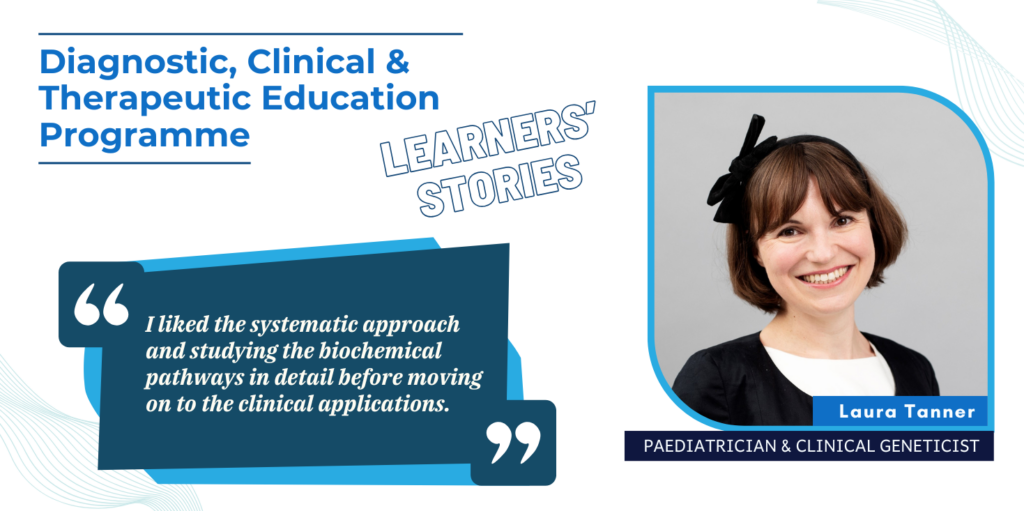
Laura Tanner, the interviewee of this “DCTEP Learner’s Story”, is a clinical geneticist from Finland. She has specialist degrees both in paediatrics and in clinical genetics and has always had a special interest in rare metabolic disorders. Laura did her PhD thesis on the long-term prognosis of lysinuric protein intolerance (LPI), a rare inborn error of amino acid metabolism. After completing her thesis, Laura has continued her research on this topic. She also works as a senior scientist in professor Outi Mäkitie´s metabolic bone disease research group and supervises several PhD students.
She is currently working as a consultant at the Department of Clinical Genetics and as the department head of the genetics services of the Fetomaternal Medical Centre of Helsinki University Hospital where she regularly meets both adults and children with metabolic diseases. She participates in the diagnostic process together with paediatricians and paediatric neurologists and laboratory physicians and gives genetic counselling to the families. She also works as a clinical lecturer at the University of Helsinki.
Q1. How did you find out about the DCTEP and what motivated you to enrol?
“I found the DCTEP when browsing the contents of the MetabERN webpage. I wanted to enrol because I have always been interested in metabolic disorders, but I felt that there were many disorders I knew next to nothing about as they are not systemically taught anywhere. There are specialist courses and webinars available about individual disorders, but the lecturers often assume that everyone is already familiar with the topic and skip the basics. I felt that DCTEP gave me a chance to target these knowledge gaps.”
Q2. What did you like the most about the DCTEP?
“I liked the systematic approach and studying the biochemical pathways in detail before moving on to the clinical applications.”
Q3. Which specific subjects, diagnostic or therapeutic approaches covered in the course did you find most valuable?
“The lectures about lysosomal and peroxisomal disorders were especially useful to me as I hadn’t really understood the complexity of these organelles before. I also had little knowledge about the laboratory diagnostics of these disorders.”
Q4. How did this course balance theoretical knowledge with practical applications in the medical field?
“The modules were rather variable in this aspect. Some were very theoretical whereas others were more patient centred. Some of the end-of-module quizzes included extremely detailed questions about biochemical pathways and reactions that were difficult to answer even when you had studied the topic carefully. On the other hand, some of the quizzes were very simple and mostly tested understanding of the basic concepts.”
Q5. In what ways has the course enriched your scientific expertise, and how do you envision applying this knowledge in your research or medical practice related to inherited metabolic diseases?
“I now have a much clearer understanding of several metabolic disorders as well as the rationale behind their treatment protocols. I believe that I will now suspect metabolic disorders more readily in my patients and I will also be better equipped to correctly diagnose these disorders.”
Q6. What other topics would you like to see covered in the future updates of the programme?
“I would like to have more lectures about specific disorders, especially lysosomal disorders and disorders of lipid and fatty acid metabolism, as only some of these disorders were covered in the course material.”
Q7. Overall, how do you describe your experience with the DCTEP and how likely are you to refer the course to a colleague?
“I have already recommended this course to several colleagues who are seeing patients with metabolic disorders. I would not recommend this course to someone who is totally new to the field of metabolic disorders as there were many expert-level modules that would not be useful without some prior knowledge on the subject. However, this programme is great for addressing knowledge gaps and obtaining better understanding about the biochemical mechanisms of metabolic disorders. I hope that more modules will be added to the programme in the future.”
The Diagnostic Clinical & Therapeutic Education Programme (DCTEP) on Inherited Metabolic Disorders (IMDs) aims to provide participants with a comprehensive understanding of metabolic rare and complex diseases, and the necessary skills and knowledge to be capable of the discussion, management and treatment of patients with these diseases in a multidisciplinary manner. The programme has as an ultimate objective to assure an adequate follow-up of patients by evaluating the status of the disease.
Find out more and register to the DCTEP.